

TL;DR: Doefin, the on-chain market for Bitcoin network difficulty, now uses SwapKit to convert native BTC into cbBTC on Base and back. Miners and traders can fund a position straight from a Bitcoin wallet and take their winnings home as native BTC, without a centralized exchange in between.
Doefin is live with SwapKit
Doefin’s markets settle in cbBTC on Base. That keeps settlement fast, cheap and non-custodial, but it created a problem the team ran into after the first few trades: their users hold BTC, not cbBTC. A miner who wanted to hedge had to find a way to get coins onto Base first, and the usual answer was a centralized exchange with an account, KYC and a withdrawal queue.
SwapKit removes that step. Doefin now uses SwapKit to swap native BTC on the Bitcoin network into cbBTC on Base in one transaction, and to swap cbBTC back to native BTC when a position closes. You send BTC from any Bitcoin wallet, and cbBTC arrives in your Base wallet ready to trade.
What Doefin does
Bitcoin miners carry a risk most holders never think about. Every 2,016 blocks, roughly every two weeks, the network adjusts its mining difficulty. When more hashrate comes online, difficulty rises and each machine earns less BTC, even if nothing changed on the miner’s side. A miner can budget for power and hardware, but not for what every other miner in the world decides to plug in.
Doefin turns that risk into something you can trade. It runs markets on where Bitcoin’s difficulty will land at a given block, and price works like probability: if you expect difficulty to be above the strike at expiry, you buy YES, and if not, NO. That gives two groups a use for the same market:
- Miners can hedge against rising difficulty and stabilise their cost per coin. If difficulty jumps, the hedge pays out and offsets the drop in mining revenue.
- Traders and Bitcoin investors can take a view on where network hashrate is heading, or trade its volatility, without running a single machine.
Markets resolve against Bitcoin itself. Doefin’s oracle reads and validates Bitcoin block headers, so the outcome comes from the chain rather than from a data provider. Doefin opened to the public in September 2026, after executing its first live difficulty hedges with miners through partners Luxor and Pow.re.
From native BTC to a position, and back
Miners are paid in BTC on the Bitcoin network, and that’s where most of them want their coins to end up. cbBTC on Base is a good settlement asset for Doefin’s markets, but it shouldn’t be a hurdle a miner has to clear before placing a hedge. With SwapKit, it isn’t.
Funding a position:
- Choose the amount of BTC you want to bring onto Doefin.
- Send native BTC from any Bitcoin wallet. The swap itself only needs a Bitcoin network fee.
- SwapKit routes the swap and cbBTC lands in your Base wallet.
- Trade on Doefin.
When a market settles or you close a position, the same route works in reverse: cbBTC on Base goes back to native BTC at a Bitcoin address you control.
A few things this changes for Doefin users:
- No exchange account. Miners don’t need to open, verify and fund an account at a centralized exchange just to get onto Base.
- One step instead of several. No buying cbBTC, bridging and withdrawing in separate moves. One swap does it.
- A clean exit to real Bitcoin. Payouts can go straight back to native BTC, which is what most miners want to hold.
Decentralized, permissionless routing
The BTC to cbBTC conversion runs through SwapKit’s decentralized providers rather than through an exchange holding your coins. Routes include:
- THORChain: run by independent node operators who secure native BTC liquidity on-chain.
- NEAR Intents: each trade is opened to a network of competing solvers.
- Flashnet: a Bitcoin-native exchange built on Spark. It uses atomic swaps and an AMM to trade BTC near-instantly, with settlement enforced by Bitcoin’s own rules.
None of them ask you to open an account.
SwapKit is non-custodial too. It finds the route and builds the transaction, you sign it from your own wallet, and funds move from your Bitcoin address through the protocol to your Base address. Every step is visible on-chain, and SwapKit’s smart contracts are open source. If one provider is down or short on liquidity, another can take the trade.
That fits how Doefin is built. Its markets resolve against Bitcoin block headers instead of a trusted data feed, and settle non-custodially on Base. Getting in and out now works the same way: no middleman deciding who can trade.
About Doefin
Doefin is an on-chain derivatives marketplace for Bitcoin network difficulty. Traders can take a view on future hashrate, and miners can hedge against rising difficulty to stabilise their revenue. Markets resolve against validated Bitcoin block headers and settle non-custodially in cbBTC on Base.
Learn more at doefin.com and follow @DoefinOfficial on X.
About SwapKit
SwapKit builds non-custodial, permissionless infrastructure for decentralized cross-chain swaps, with open-source smart contracts. Through one API and SDK, wallets, dApps and other platforms get access to native swaps across 30+ blockchains and 10,000+ assets, aggregated from providers including NEAR Intents, THORChain, Chainflip and Maya Protocol. Integrators can set their own swap fees, track transaction status and run address screening.
Building an app that needs native BTC in or out? Talk to the team or read the docs.
Follow along on X, Discord and LinkedIn.
This article is for informational purposes only and is not financial advice.
Keep reading
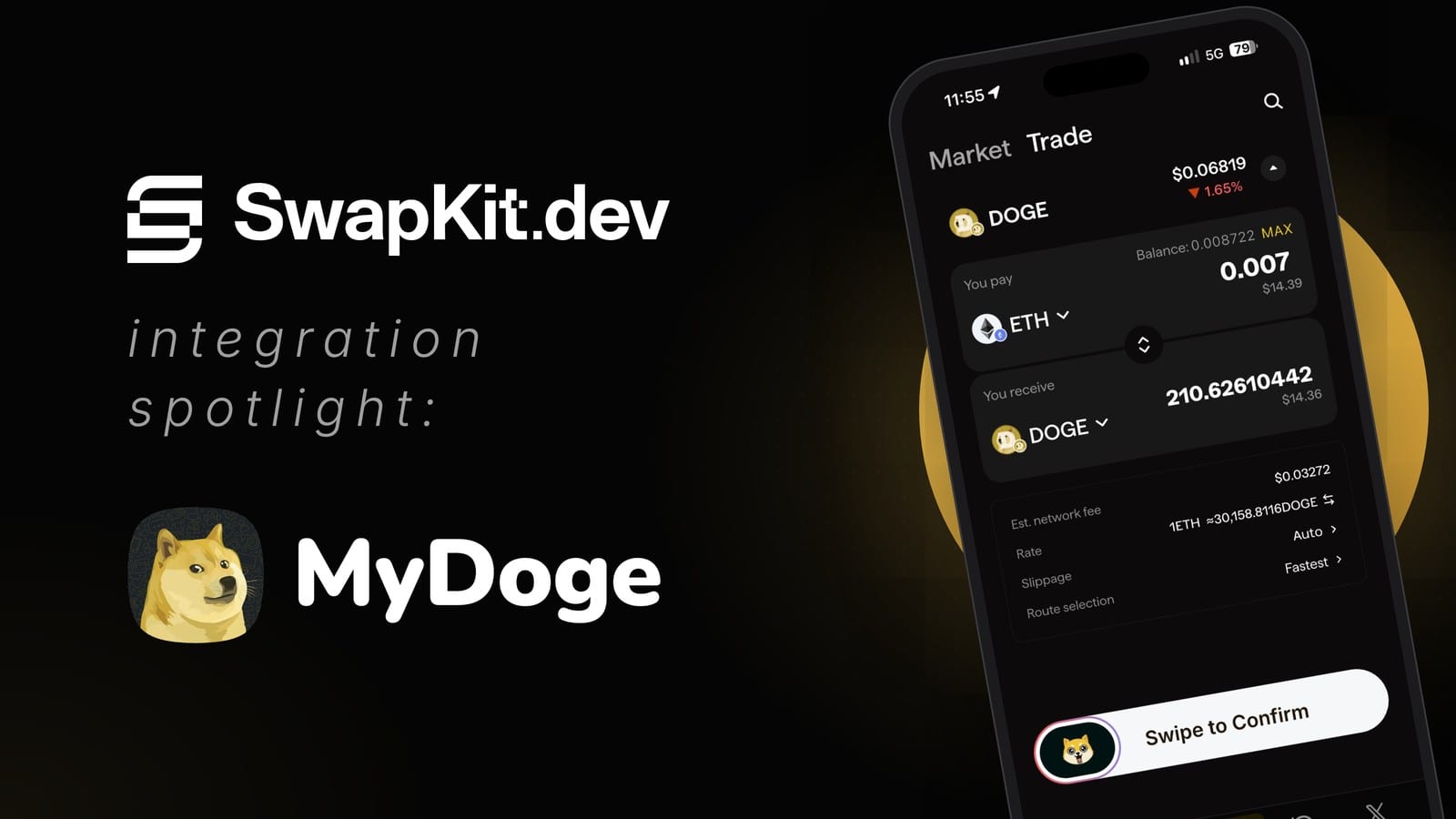
MyDoge Goes Live With SwapKit: Native Swaps Between DOGE, Bitcoin, Ethereum, Solana and More
MyDoge is live with SwapKit: swap native DOGE to and from Bitcoin, Litecoin, Ethereum, Solana and Robinhood Chain in the wallet, with keys staying in it.
Trezor Goes Live With SwapKit: Native Swaps Across Bitcoin, Zcash, EVM, Solana, Tron, XRP and More
Trezor is live with SwapKit: swap native assets across Bitcoin, Zcash, EVM chains, Solana, Tron and XRP, confirmed on the device, with keys staying on it.
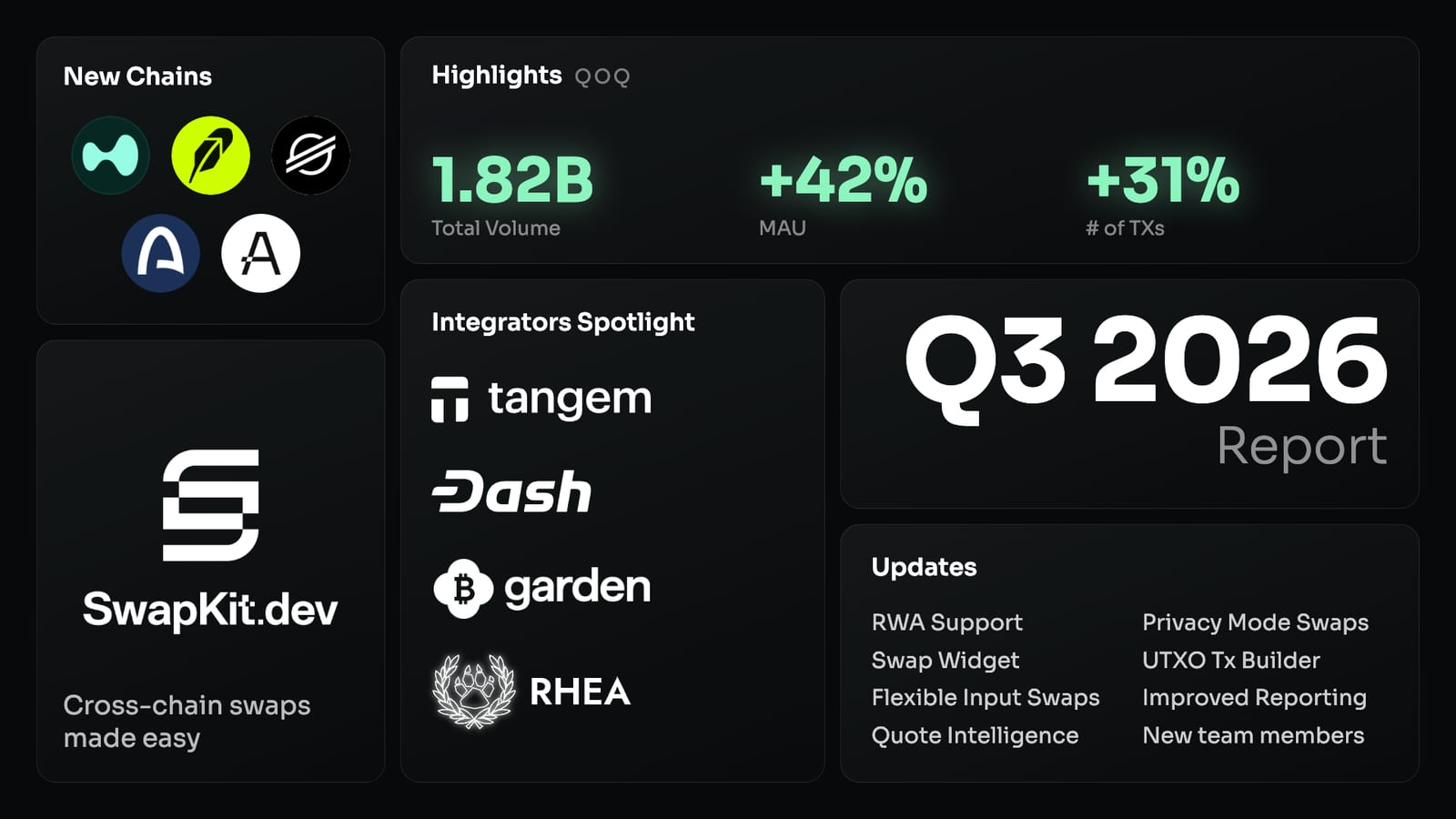
SwapKit Quarterly Report – Q3 2026
SwapKit Q3 2026 report: record $1.82B swap volume, up 36.5% quarter over quarter, driven by RWA swaps on Robinhood Chain and the Tangem integration.